ATTENTION:
2Accommadations Left. Act Now.
1 Queen Room and 1 Bunk Room (double bunks)
Nature & Movement as Medicine
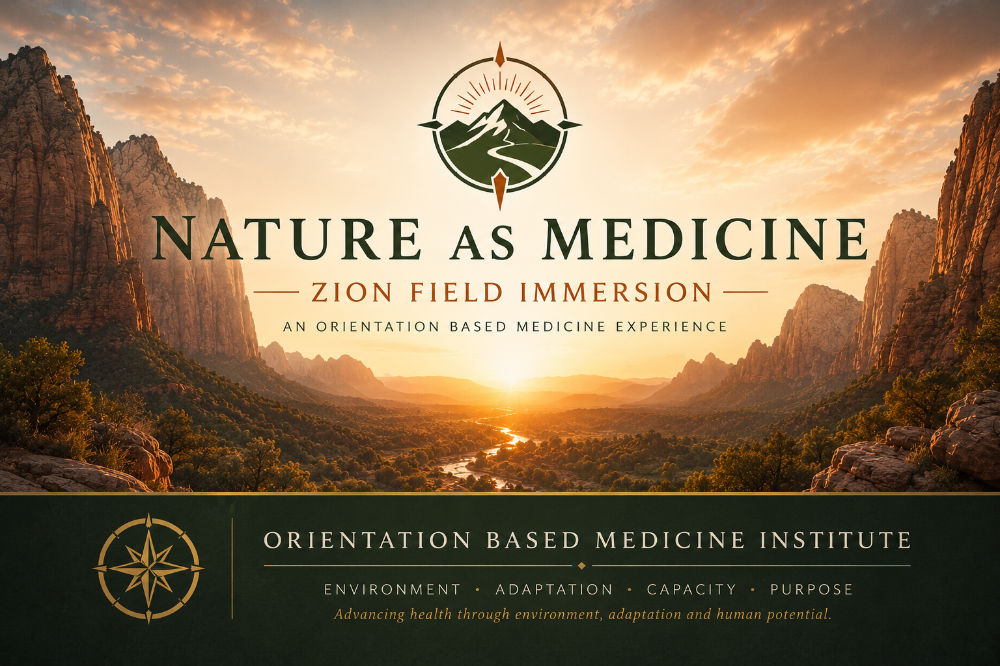
NATURE AND MOVEMENT AS MEDICINE An Immersion in Zion and Kolob Canyon, Utah October 29–31, 2026 Optional Arrival: October 28 — Departure: November 1
A transformational field experience for practitioners and non-practitioners ready to understand how environment, adaptation, capacity, movement, silence, and adventure shape human health — and how to apply those principles clinically and in ones life.
Reserve Your Spot
The question most of us were never taught to ask
We spend so much of life trying to understand the body. The symptoms. The patterns. The stress. The fatigue. The disconnection. The reasons we feel stuck, depleted, or not fully ourselves.
And yet something keeps getting missed.
Not because we are broken. Not because we need another protocol, productivity hack, or wellness plan.
But because we often forget to ask the question underneath it all:
What environment is shaping this person?
And what has this person become adapted to?
When you can begin to answer those two questions, everything changes.
The way you understand your health.
The way you relate to your body.
The way you move through stress.
The way you make decisions.
The way you reconnect with yourself, others, and the natural world.
For practitioners, this changes the way you see your clients and patients.
For non-practitioners, this changes the way you see yourself.
Nature as Medicine was created to help you explore these questions, not in a classroom, not through more information, but in the field, where the answers have always lived.
Why Zion?
Because the canyon itself is the classroom.
The trail is the assessment. The environment is the teacher. The practitioner becomes the student.
Zion and Kolob Canyon strip away the noise of modern life with a precision no protocol can replicate. What remains — what becomes visible when stimulation decreases, urgency disappears, and space is finally created — is the baseline most practitioners have never accessed in their patients. Or in themselves.
When stimulation decreases
What emerges?
When urgency disappears
What remains?
When space is created
What becomes visible?
When nature is the mirror
What does it reveal?
Forest bathing teaches us that nature heals. Orientation-Based Medicine asks a deeper question: what is nature revealing?
In Zion, the answer is always the same. The truth about where a person actually is.
What makes this different from every other retreat, training, or continuing education experience?
Most CE programs give you more information to layer on top of what you already know.
Nature as Medicine gives you a new way of seeing.
Not a new protocol. Not a new supplement category. Not a new testing strategy.
A framework for understanding the environment shaping your patient before you ever order a lab — and the clinical language to work with what you find.
Nature becomes five things simultaneously:
- Medicine — direct therapeutic input through ecological reconnection
- Assessment — a tool for revealing adaptation patterns invisible in a clinical setting
- Capacity builder — challenge, movement, and uncertainty restore what modern life erodes
- Teacher — the landscape communicates what no textbook can
- Orientation tool — nature shows a person where they actually are
The four pillars of the immersion
Nature
Reconnect with the ecological baseline. Understand what environment actually does to the human system.
Space & silence
Learn what becomes visible when distraction is removed. Silence as clinical assessment tool.
Movement
Experience MovNat and natural movement as environmental interaction — the body in its native context.
Adventure
Discover how challenge, exploration, and uncertainty restore aliveness and expand capacity in your patients — and in you.
The four-day journey
Each day follows one of the four directions — a compass framework that mirrors the OBM orientation model and takes practitioners through a complete arc of immersion, from arrival to integration. There will be alternatives to the hikes listed below in accordance with your path.
Day 1 — East
Vision
Watchman Trail
Nature creates space.
Day 2 — South
Growth
West Rim Descent
Silence reveals.
Day 3 — West
Transformation
Angels Landing
Adventure restores aliveness.
Day 4 — North
Wisdom
Kolob Canyon
Nature becomes a reference point.
What you will leave with
-
A framework for environmental therapeutics you can apply immediately, whether in your own life, your work with others, or your clinical practice.
-
Nature as assessment — how to read ecological adaptation patterns in yourself, clients, or patients
-
Silence as a diagnostic tool — what becomes visible when stimulation is removed
-
Adventure as medicine — how challenge, uncertainty, and exploration can restore capacity
-
Movement ecology — natural movement as environmental interaction, not just exercise
-
Capacity development frameworks — how to meet a person at their current stage of readiness
-
Environmental mismatch — identifying the ecological roots of modern dysfunction
-
The Four Directions framework — a practical way to understand orientation, adaptation, and reconnection
Institute of Orientation-Based Medicine
Level II Certification
This field immersion serves as the flagship Level II Certification experience of the Institute of Orientation-Based Medicine — training practitioners to understand health through the lenses of environment, orientation, adaptation, capacity, meaning, and human flourishing.
Not just another course to add to your credentials. A permanent shift in how you see and work with the people in front of you.
Nature doesn't just heal us. Nature reveals us.
Every person who walks into Zion walks out seeing differently. Not just the landscape. Their patients. Their practice. Themselves.
Because once you've experienced what nature reveals — about adaptation, about capacity, about what a human being looks like when the noise of modern life is removed — you cannot unsee it.
And neither can your patients, when you bring that lens back into the room with you.
Applications now open
Nature as Medicine — Level II Field Immersion
Four Days. Three Nights. Zion & Kolob Canyon, Utah.
Cohort size is intentionally limited. This work requires space — for the landscape to do what it does, and for practitioners to receive what it offers.
ACCOMADATIONS, FlOW AND THE SETTING
The immersion is hosted at a private villa on more than 10 acres within the Kolob Canyon wilderness area.
Red rock cliffs. Open skies. Direct access to nature. Five bedrooms, a large kitchen, a spacious great room for teaching and group discussion, three outdoor patios, and a fire pit gathering area.
Close enough to Zion National Park and in the heart of the Kolob Canyon for daily field experiences. Private enough to create genuine space for reflection, learning, and restoration.
The property itself becomes part of the curriculum. We will be studying the very environments that influence human physiology, attention, recovery, resilience, and adaptation — while living inside one of them.
THE FLOW OF THE EXPERIENCE
Each day has structure, direction, and clear learning objectives. Each day also leaves room for reflection, observation, conversation, movement, and personal exploration.
That balance is intentional. It is part of the curriculum.
Mornings begin with discussion, instruction, and experiential learning — a framework for the day. From there, we take those ideas into the field. Onto the trails. Into movement. Into direct observation.
The landscape becomes part of the classroom. The conversations become part of the learning. And the quiet moments become part of the integration.
Day One — Orientation and Embodiment Foundations of Nature and Movement as Medicine through the OBM lens. Environment as therapeutic input. Movement as information. Capacity and adaptation. The practitioner as environment. Then into the field — one possible experience is the Watchman Trail, a powerful setting for exploring these themes in a direct and embodied way.
Day Two — Nature, Capacity, and Clinical Application Deeper exploration of environmental medicine, capacity development, movement assessment, and human adaptation. How these concepts influence patient outcomes, clinical recommendations, lifestyle interventions, and practitioner wellbeing. The field experience becomes an opportunity to observe these principles in real time.
Day Three — Integration and Implementation Translating experience into practice. Clinical application. Patient communication. Nature prescriptions. Movement recommendations. Workshop and program development. Each participant leaves with a practical implementation plan and a clear next step for integrating this work into both their professional and personal life.
There will be basic breakfast provided; coffee, tea, filtered water, yogurt, hard boiled eggs, etc- There will also be community dinners, conversations around the fire, a group dinner in Springdale, and a closing certification ceremony on the final evening.
And if you want the best breakfast café in the area as well as other favorite eating options as well as favorite trails — I have a list. I'll show you when we get there.
THE EXPERIENCE BEGINS BEFORE ZION
Before you arrive, you'll complete:
OBM Practitioner Assessment Practice Architect Assessment Capacity Assessment Nature and Movement Assessment
Each participant receives a personalized OBM Field Guide outlining strengths, blind spots, growth opportunities, and a personalized developmental edge — along with a private one-on-one orientation session with me before the immersion begins.
You will not arrive as a stranger to this work. You will arrive oriented.
THE EXPERIENCE CONTINUES AFTER ZION
The immersion officially continues for 30 days after you return home.
Guided reintegration exercises. Weekly reflection prompts. Group coaching calls. Clinical and practice implementation support. And a final deliverable — your personalized Nature and Movement Integration Blueprint — outlining how you will continue the work personally, clinically, and professionally.
The goal is not simply to learn something.
The goal is to implement it.
LODGING OPTIONS
The villa has five bedrooms. Spots are reserved on a first-come, first-served basis.
The villa has five bedrooms. Lodging will be reserved on a first-come, first-served basis.
Queen Rooms (1 Left)
Three private queen bedrooms are available.
Founding Cohort Early Bird Pricing: $3,000
Standard Pricing: $3,250
With spouse or partner: $3,500 (Early Bird Pricing)
Bunk Room
One bedroom includes bunk beds.
This room may be shared by two practitioners or reserved privately by one practitioner.
Shared Bunk Room: (Discounts available for group of 2-4 people)
Founding Cohort Early Bird Pricing: $1,500 per practitioner
Standard Pricing: $1,750 per practitioner
Private Bunk Room (Claim this room for yourself):
Founding Cohort Pricing: $2,500
Standard Pricing: $2,750
Certification Only
No lodging included.
This option is ideal for local attendees, camper attendees, or those staying elsewhere.
Certification Only Early Bird Pricing: $2,250
BRINGING A PARTNER
This is part vacation, part adventure, part next chapter of your practice.
If there is someone in your life who has been watching you build this work — this is a chance to bring them along. They don't need to participate in the training. They just need to show up in one of the most spectacular places in the country while you do.
$500 gets them there.
COMING SOLO
Coming alone may be the most powerful version of this experience.
No schedule to negotiate. No divided attention. Just you, the canyon, a small group of practitioners who already speak this language, and three days to think, explore, and reconnect with the work — and with yourself.
The group will be small enough that by day two, strangers become colleagues and colleagues become friends.
ABOUT ROB KRESS
Rob Kress
Founder, Orientation-Based Medicine · Functional Pharmacist · MovNat Certified · Executive Coach
For over two decades Rob has explored the intersection of physiology, environment, movement, adaptation, and human potential. Nature as Medicine is the culmination of that work — a field immersion designed to give practitioners the framework, the language, and the lived experience of what orientation-based clinical thinking actually looks like in practice.
FREQUENTLY ASKED QUESTIONS
Is this a retreat?
Honestly, yes and no.
It has elements of a retreat.
It has elements of a training.
It has elements of a certification.
It has elements of an adventure.
What it is not is a traditional conference, classroom experience, or highly structured retreat where every hour is scheduled.
The Nature and Movement as Medicine Immersion is designed around the principles we teach in Orientation-Based Medicine:
• Capacity
• Adaptation
• Environment
• Movement
• Recovery
• Direction
The goal is not to escape life.
The goal is to return to it differently.
Do I need to be highly fit or an experienced hiker?
Not at all.
This experience is intentionally designed to meet practitioners where they are.
There will be:
• Multiple trail options
• Different levels of challenge
• Spaciousness for recovery and reflection
• Opportunities for both adventure and restoration
• Adaptable movement experiences
Some participants may choose:
• Scenic walks
• Nature observation
• Photography
• Coffee and reflection in Springdale
• Easier hikes and canyon exploration
Others may choose:
• Longer hikes
• Greater elevation gain
• More physically demanding routes
• More adventurous experiences
Both are respected.
The goal is not athletic achievement.
The goal is embodiment.
What if I've never done anything like this before?
Perfect.
Many participants may be new to:
• Retreats
• Immersive learning experiences
• OBM
• Wilderness experiences
• Nature-based medicine concepts
• Movement education
This experience is intentionally designed to feel:
• Approachable
• Grounded
• Supportive
• Spacious
• Practical
There is no expectation to perform physically, professionally, or socially.
What exactly will I learn?
Participants will explore:
• Nature as therapeutic input
• Movement as information
• Environmental medicine
• Capacity and adaptation
• Recovery and resilience
• Attention and nervous system regulation
• Human performance through an OBM lens
• Clinical application of nature and movement interventions
• Patient communication strategies
• Program and workshop development opportunities
The goal is not simply information acquisition.
The goal is implementation.
What is Orientation-Based Medicine (OBM)?
OBM is a framework developed by Rob Kress that examines:
• Nervous system state
• Capacity
• Adaptation
• Behavior
• Environment
• Physiology
• Recovery
• Direction
Rather than asking:
"What protocol does someone need?"
OBM asks:
"What state are they in?"
"What capacity do they currently have?"
"What environmental influences are shaping outcomes?"
"What direction are they moving?"
This framework influences both the curriculum and the structure of the immersion itself.
What assessments are included?
Before arriving, participants will complete:
• OBM Practitioner Assessment
• Practice Architect Assessment
• Capacity Assessment
• Nature and Movement Assessment
Participants will also receive a private one-on-one orientation session with Rob.
From these assessments, a personalized OBM Field Guide will be created.
This may include:
• Strengths
• Blind spots
• Capacity considerations
• Growth opportunities
• Practice development opportunities
• Clinical implementation ideas
• Personalized reflection prompts
The goal is to arrive already oriented to the experience.
What does a typical day look like?
Each day includes both structure and freedom.
Mornings typically begin with:
• Discussion
• Teaching
• Reflection
• Practical application
From there, participants move into field experiences aligned with the theme of the day.
Possible themes may include:
• Immersion
• Capacity
• Challenge
• Perspective
• Vision
• Integration
Participants can choose experiences that best fit their interests and current capacity.
The destination is not the curriculum.
The experience is.
Is everything done as a group?
No.
While there will be shared learning experiences, meals, conversations, and group gatherings, there is also intentional space for:
• Solitude
• Reflection
• Exploration
• Recovery
• Journaling
• Photography
• Personal adventure
The goal is not constant stimulation.
Some of the most valuable learning may happen during quiet moments.
Can I bring my spouse or partner?
Absolutely.
Many participants may choose to turn this into a shared adventure.
While you're participating in training sessions and field experiences, your spouse or partner can enjoy:
• Zion National Park
• Kolob Canyon
• Springdale
• Local cafés
• Hiking
• Photography
• Relaxation
• Exploration
Then reconnect at the end of the day.
Dinner.
Conversation.
Sunsets.
Adventure.
The experience doesn't have to exist separately from your life.
It can become part of it.
Partner options are available with select lodging accommodations.
Will there be forced sharing, group processing, or emotional exercises?
No.
Meaningful conversations may naturally emerge.
Reflection may occur.
Personal insights often arise in environments like this.
But there will never be pressure to:
• Overshare
• Participate in public vulnerability
• Engage in performative exercises
• Process emotions publicly
The environment itself often creates the conditions for insight.
We don't need to force it.
Will this help me grow my practice?
Very possibly.
While this immersion is first and foremost about learning, embodiment, and professional development, many practitioners will likely leave with ideas that directly influence their practice.
We'll explore how nature, movement, environment, capacity, and adaptation can be incorporated into:
• Patient recommendations
• Lifestyle interventions
• Group programs
• Workshops
• Community events
• Retreat experiences
• Membership programs
• Clinical conversations
• Patient education
You'll also complete the OBM Practice Architect Assessment before arriving.
Many practitioners discover that their greatest opportunity for growth isn't another protocol.
It's greater clarity.
Greater alignment.
Greater differentiation.
And a better understanding of what they are uniquely positioned to offer.
My hope is that you leave not only with new clinical tools, but with a clearer vision for where your practice is heading.
What is included for food?
This is intentionally designed to feel more like staying at a great house with friends than attending a conference.
No one is coming to Zion for conference chicken.
Each morning, the house will be stocked with breakfast provisions such as:
• Coffee
• Tea
• Filtered water
• Yogurt
• Fruit
• Eggs
• Oatmeal
• Other simple breakfast options
Participants will also have access to trail provisions and hiking snacks throughout the experience.
Think things like:
• Trail snacks
• Protein options
• Hydration support
• Grab-and-go foods for the day
A few evenings will be centered around community meals at the property.
Good food.
Good conversation.
A fire going.
Stories from the day.
Time to reflect, laugh, learn, and connect.
We'll likely prepare a couple dinners together at the villa and spend time around the fire pit under the desert sky.
We'll also likely spend an evening in Springdale enjoying one of the local restaurants.
Burgers.
Tacos.
A great meal.
Maybe a beer or a glass of wine.
Nothing overly formal.
And if at some point you decide you'd rather go off on your own, grab a meal at one of the cafés, explore Springdale, or have dinner with your spouse or partner, that's completely okay too.
As with everything else about this immersion, the goal is connection, nourishment, and experience rather than rigid structure.
What if I have health concerns or physical limitations?
This experience is intentionally adaptable.
Participants are encouraged to operate within their current level of capacity.
Alternative experiences and trail options will be available.
If you have questions regarding a specific concern, you're encouraged to reach out before enrolling.
What airport should I fly into?
Most participants will likely fly into:
• Las Vegas (LAS)
• St. George Regional Airport (SGU)
• Salt Lake City (SLC)
Las Vegas is often the most affordable and convenient option.
Approximate driving times:
• Las Vegas: 2.5–3 hours
• St. George: 45–60 minutes
• Salt Lake City: 4.5–5 hours
Will transportation be available?
Potentially.
Transportation coordination may be available depending on final attendance numbers and arrival schedules.
Participants may also choose to rent their own vehicles for maximum flexibility.
Additional travel information will be provided after enrollment.
What is the Optional Landing Day?
The Optional Landing Day (October 28) is available for those who want additional time to:
• Settle in
• Explore the area
• Acclimate
• Connect casually with other participants
• Enjoy Zion before the immersion begins
Think of it as a soft arrival rather than an additional training day.
No pressure.
No formal curriculum.
Just space to land.
What happens after the immersion?
Certification continues for 30 days after returning home.
Participants receive:
• Integration exercises
• Reflection prompts
• Group coaching support
• Practice implementation guidance
• Clinical application support
Each participant also receives a personalized Nature and Movement Integration Blueprint.
Because implementation matters.
The goal isn't simply to have an experience.
The goal is to bring it home.
How many practitioners will attend?
This experience is intentionally limited.
While the property can accommodate more, the ideal group size is likely six to eight practitioners.
This allows for:
• More personalization
• Better conversations
• Greater flexibility
• Stronger relationships
• A more meaningful experience overall
Small groups create better experiences.
What does the certification include?
Upon completion, participants receive Certification in Nature and Movement as Medicine through the Institute of Orientation-Based Medicine.
Certification includes:
• Pre-event assessments
• Private orientation session
• Personalized OBM Field Guide
• Three-day immersion experience
• Nature and Movement as Medicine curriculum
• Post-event integration process
• Nature and Movement Integration Blueprint
• Certificate of Completion
The emphasis is not simply on knowledge.
It is on embodiment.
Application.
And implementation.
Is my deposit refundable?
Due to the intimate nature of the experience and limited capacity, deposits are non-refundable.
However, if circumstances prevent you from attending, your deposit may be applied toward:
• Future OBM immersions
• OBM training programs
• Coaching programs with Rob
• Other qualifying educational experiences
If questions arise regarding your situation, please reach out before enrolling.
Why Zion?
Because environment matters.
As practitioners, we spend much of our lives discussing health inside exam rooms, offices, conference centers, and Zoom calls.
Yet many of the forces that shape human physiology are experienced outside of those environments.
Sunlight.
Movement.
Challenge.
Recovery.
Silence.
Beauty.
Perspective.
Connection.
Nature changes how we think.
How we feel.
How we recover.
How we adapt.
Part of the purpose of this immersion is not simply to learn about these concepts intellectually.
It is to experience them directly.
Because some lessons are better understood on a trail than in a classroom.
And some of the best teachers don't use PowerPoint.